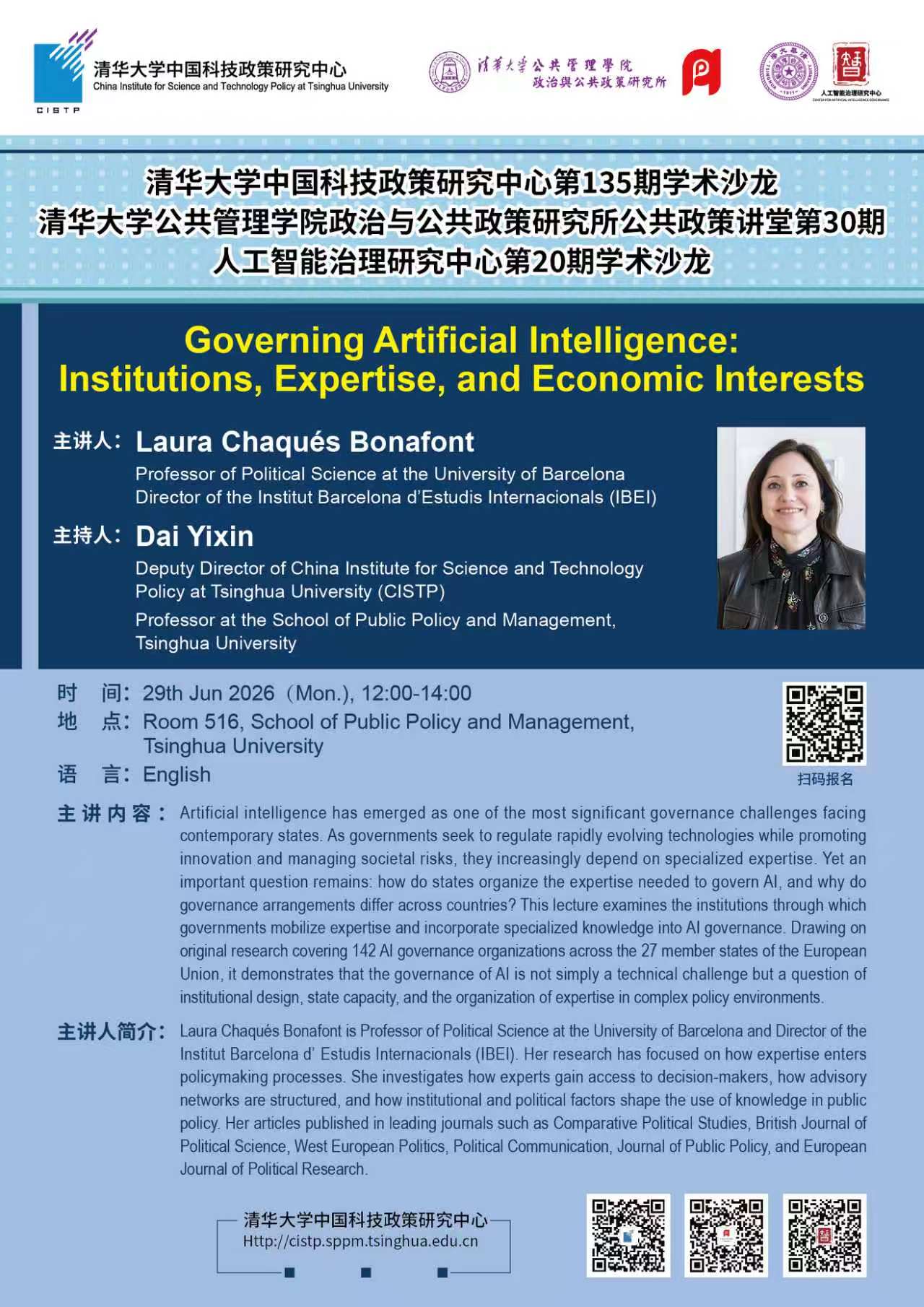
时间:29th Jun 2026(Mon.), 12:00-14:00
地点:Room 516, School of Public Policy and Management, Tsinghua University
语言:English
主题: Governing Artificial Intelligence: Institutions, Expertise, and Economic Interests
主讲:Laura Chaqués Bonafont
Professor of Political Science at the University Barcelona
Director of the Institut Barcelona d’Estudis Internacionals (IBEI)
主持:Dai Yixin
Deputy Director of China Institute for Science and Technology Policy at Tsinghua University (CISTP)
Professor at the School of Public Policy and Management, Tsinghua University
主讲内容:
Artificial intelligence has emerged as one of the most significant governance challenges facing contemporary states. As governments seek to regulate rapidly evolving technologies while promoting innovation and managing societal risks, they increasingly depend on specialized expertise. Yet an important question remains: how do states organize the expertise needed to govern AI, and why do governance arrangements differ across countries? This lecture examines the institutions through which governments mobilize expertise and incorporate specialized knowledge into AI governance. Drawing on original research covering 142 AI governance organizations across the 27 member states of the European Union, it demonstrates that the governance of AI is not simply a technical challenge but a question of institutional design, state capacity, and the organization of expertise in complex policy environments.
主讲人简介:
Laura Chaqués Bonafont is Professor of Political Science at the University of Barcelona and Director of the Institut Barcelona d’Estudis Internacionals (IBEI). Her research has focused on how expertise enters policymaking processes. She investigates how experts gain access to decision-makers, how advisory networks are structured, and how institutional and political factors shape the use of knowledge in public policy. Her articles published in leading journals such as Comparative Political Studies, British Journal of Political Science, West European Politics, Political Communication, Journal of Public Policy, and European Journal of Political Research.